Sizing a First Rig With the Profit Calculator
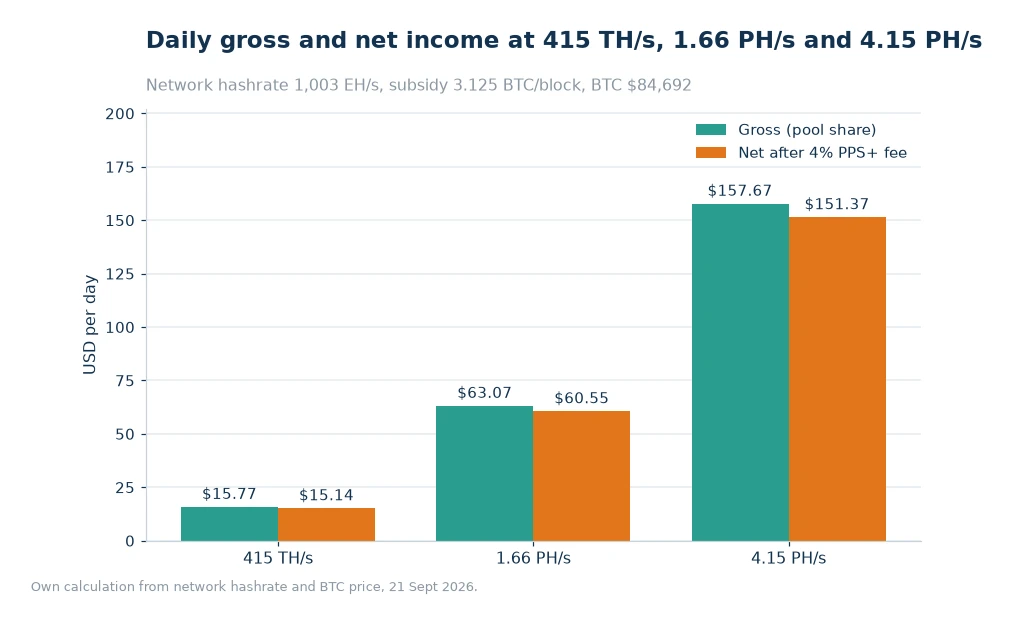
A first purchase is a hashrate decision wearing a budget costume. At 415 TH/s the pool pays 0.00018617 BTC a day, which is $15.77 gross and $15.14 after the listed 4% on the block-reward component. At 4.15 PH/s the same arithmetic gives $157.67 gross and $151.37 net. Run both ends before picking a machine in the middle.
Key takeaways
- 415 TH/s earns 0.00018617 BTC a day: $15.77 gross and $15.14 once the listed 4% charge on block rewards is taken off.
- Every input in the Profit Calculator except hashrate is a guess, so treat the output as a range rather than a quote.
- Ten times the hashrate is ten times the coins and roughly ten times the heat, which the tool does not model.
- Re-run the numbers on delivery day; a week of price movement can change the ranking of two machines.
What the tool needs from you
The ViaBTC Mining Calculator asks for coin price, network difficulty, a fee assumption and effective hashrate. Four fields, one output, and three of the four will be wrong by the time the hardware is unboxed. That is not a flaw in the tool; it is the nature of projecting a moving network.
Effective hashrate is the field most buyers get wrong, because it is not the number on the box. A unit rated at 415 TH/s running warm, with a slight overclock removed by firmware, may deliver 400 TH/s on a bad afternoon. Enter the figure you expect on an ordinary day, not the peak from a review video.
Inputs that move the answer most
Price and difficulty move the answer in opposite directions and by different amounts. A ten percent move in BTC price changes the dollar output by ten percent. A ten percent move in difficulty changes the coin output by about nine percent, because the network share shrinks. Fee assumption matters least in percentage terms but is the one input you can actually verify against a published page.
That ranking is the practical reason to check the fee last. Two machines with the same price and hashrate differ by nothing under either settlement mode, so the fee cannot decide between them. It can only decide whether the whole exercise clears your power cost, which is a different question and belongs in a different column.
Three sizes, one decision
The table puts the chart's three rungs into the units a buyer uses: daily dollars, net after the listed rate, and how many days of output equal $100.
| Rung | Hashrate | BTC per day | Gross | Net | Days per $100 |
|---|---|---|---|---|---|
| Single unit | 415 TH/s | 0.00018617 | $15.77 | $15.14 | 6.6 |
| Four units | 1.66 PH/s | 0.00074467 | $63.07 | $60.55 | 1.7 |
| Ten units | 4.15 PH/s | 0.00186172 | $157.67 | $151.37 | 0.7 |
The last column is the useful one for a first purchase. A single unit takes about a week to produce $100 of gross value; a ten-unit rack does it in under a day. Neither figure says anything about profit until power and hardware cost are subtracted, but both say something about how quickly a mistake compounds.
Reading the output as a range
Run the tool three times: once with today's difficulty, once with difficulty five percent higher, and once with the price ten percent lower. The three outputs form a band, and the band is the honest answer. A single number invites a decision; a band invites a decision with a margin, which is what a first purchase needs.
My own rule is to buy only when the low end of the band still covers power and a modest hardware amortisation. That rule rejects some machines that would have worked out and accepts none that would have failed badly, which is the correct asymmetry for someone buying their first unit rather than their fiftieth.
Write the three runs into one note with the date. A band without a date is just a rumour about the future, and the first thing you will want when the second machine is tempting is the number you actually used the first time.
Power cost sits outside the pool number
Nothing in the calculator output includes the wall socket. At 415 TH/s the pool credit is $15.14 net of the listed rate, and the electricity bill arrives separately, priced in your currency and your tariff. A machine that looks marginal in the tool can be clearly negative at the meter, and vice versa.
Do the subtraction on paper before ordering. Take the net daily figure, multiply by 30, and subtract the monthly power estimate for continuous operation. If the remainder is small, the purchase is a bet on price rather than a business, and it should be sized like a bet rather than like a business.
A purchase rule you can apply twice
Write the rule down before browsing listings, because listings are designed to move the rule. Mine has three clauses: the low-end band must cover power, the machine must fit an existing circuit, and the payback period at the low end must be shorter than the warranty. Each clause is checkable without a spreadsheet, and together they rule out most impulse buys.
Use the same rule when the second machine arrives. A purchase rule that only works once is a mood, not a rule. The second unit should clear the same three clauses against the same band, recalculated with the hashrate you now actually run rather than the one you hoped for.
Worked example
Take the single-unit rung and carry it through the tool's fields.
- Hashrate in gigahash: 415 TH/s = 415,000 GH/s.
- Network share: 415,000 ÷ 1,003,107,267,295 = 0.00000041373.
- Daily coins: 0.00000041373 × 450 = 0.00018618 BTC, shown as 0.00018617 in the chart.
- Gross dollars: 0.00018617 × 84,692 = $15.77.
- Listed 4% line: 15.77 × 0.04 = $0.63.
- Net: 15.77 − 0.63 = $15.14 a day, or $454.20 across 30 days.
- Scale check: 4.15 PH/s is ten times 415 TH/s, so $15.14 × 10 = $151.40, against $151.37 in the chart after rounding.
That one-cent gap is worth understanding. Each step rounds to the nearest cent, and ten of those roundings can drift either way. It is not a fee and not an error in the tool; it is what happens when a daily figure is carried to two decimals and then multiplied.
Frequently asked questions
What hashrate should I enter for a used machine?
Enter the rate it holds after twenty minutes of steady work, not the sticker figure; a used unit at 415 TH/s nominal may sit a few percent below that once the firmware settles and the ambient temperature is realistic.
Does the tool include the pool fee?
The Profit Calculator takes a fee field, so enter the listed rate that applies to your settlement mode; PPS+ uses 4% on the block-reward component, and the output should be read as an estimate rather than a settlement figure.
How often should I re-run the numbers?
Before ordering, on delivery day, and after any difficulty adjustment larger than a couple of percent; a machine that cleared the rule at 132.76 T difficulty may not clear it after two upward adjustments.
Run it again after the rig lands
The projection was always a guess. Once the machine runs, replace the guessed hashrate with the measured figure and keep the same fee and price assumptions for one week. If the measured output lands inside the band you bought against, the decision was sound even if the market later moves. If it lands below the band, find out why before buying anything else, starting with the Miner Profitability Ranking and the published fee schedule rather than a forum thread.
Sources: calculator, miner ranking and fee schedule pages at viabtc.com. Inputs dated 21 Sept 2026: 132.76 T difficulty, 1,003 EH/s network hashrate, BTC at $84,692, 3.125 BTC per block over 144 blocks daily[1]. Outputs presume uninterrupted running. Published 24 Oct 2026.